


Maybe you’ve heard the concept “gradually, then suddenly.” It describes making incremental changes to build and master fundamentals, with these changes compounding over time, until Wham! You’ve reached new capability thresholds that enable business model disruption and transformation.
That’s our strategy for leveraging AI to benefit our company and our clients. For all of you pursuing your own AI journey, we provide a practical roadmap with guideposts that lays out much of our philosophy and approach in our new white paper, Implementing AI to Improve Transactional Customer Communications.
We’ve been working diligently behind the scenes on AI enablement across the business and Expresso platform, using our internal data to train a proprietary large language model (LLM) in a closed loop and to power other AI tools and applications. With AI enablement, we are developing and/or modifying and integrating AI technologies into our workflows, data systems, and culture to increase efficiency, foster innovation, and enhance data-driven decision-making.
From omnichannel to AI-enabled orchestration
For clients, our goal is to empower you to automate orchestrated communications, especially to drive more and faster payments. It’s no longer about offering multiple delivery channels. It’s not even about the next leap forward, which is automating the sequencing of communications across channels, which you can do now with Expresso.
Communications orchestration entails leveraging AI to automatically collect and assess data in real-time to react to an event, whether it’s a customer doing something (opening an email, visiting a payment portal, paying a bill online, etc.) or not doing something (visiting the payment portal but not making a payment, not clicking on the text, etc.) It also incorporates past customer behavior and stated preferences and digital consents to hyper-personalize the next interactions by channel, message and more.
AI will let companies create a communications system that knows what’s happening in all channels in real-time and when customers are engaged. An AI-enabled communication system will have a complete view of the customer journey versus a program that sends a series of communications.
Ultimately, it’s about creating an automated, real-time decision model for every event.
Early AI progress
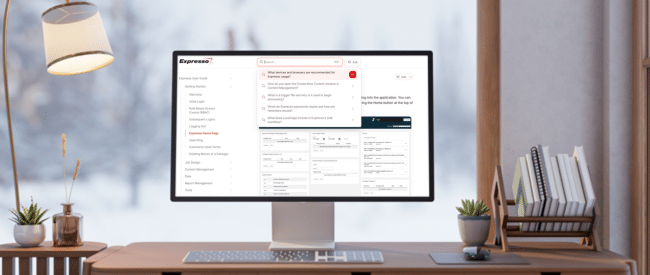
The Expresso orchestration layer is in development, along with other AI-based customer-facing and internal advances. And momentum is building. You are beginning to see the fruits of our labor, with the new Expresso user manual described in this newsletter’s product showcase article.
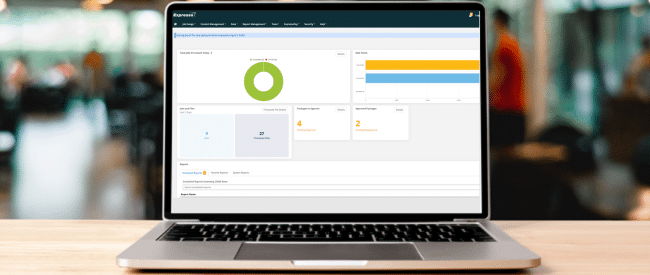
Another example is the updated Expresso home page dashboard, which just launched, and covered in this newsletter issue’s Enhancements to the Expresso® User Experience. The dashboard is a precursor to a robust, AI-driven data and analytics resource which we call ExpressoHub™.
Expresso is pulling data from ExpressoHub™ to automatically create the graphs, images and other dashboard information customized to each client. We are building out more functionality, with the initial phase designed to automatically generate each client’s consolidated communication and payment reports and key performance indicators.
All AI innovations are aimed at helping you improve your programs, either directly like ExpressoHub™, or through operating and efficiency improvements at Nordis. In all cases, humans will remain integrally involved to ensure accuracy and integrity.
We are excited about the future and look forward to sharing more as we bring on other AI-enabled capabilities.