


When I joined Nordis in 2016, prospective clients contacted us when they went looking for a transactional print and mail provider, not an omnichannel customer communication management (CCM) technology partner with print and mail services. Fast forward 10 years and many companies now seek us out because they, first and foremost, want a first-class omnichannel CCM solution to develop and distribute transactional communications.
But make no mistake: Transactional print and mail services remain a critical requirement for strategic customer communications programs.
Sometimes it’s a matter of necessity, when mailed communications are the only way to reach customers or are legally required:
- Nearly 16 million Americans don’t have access to broadband services and 81 million choose not to pay for broadband services, according to 2026 analysis of U.S. Census data by Connected Nation.
- Physical mail, including Certified Mail® and Registered Mail®, are mandated for documents necessitating strict proof of delivery, signatures in ink, or high security, including foreclosures, HIPAA notices and insurance policy cancellations.
More strategically, leading companies no longer see print and digital as either/or. They understand the value and need for both. Instead of pushing all customers to go all digital, these companies have recalibrated their communications to a digital-first approach that recognizes and satisfies the continuing demand for transactional print and mail services.
By centralizing transactional print and mail, email and text communications on an omnichannel CCM platform, the focus is on optimizing, rather than replacing, channels to improve customer experience and business outcomes. It enables using the right channels for the right reasons, such as catering to people who want mailed billing statements for their records but prefer text payment reminders.
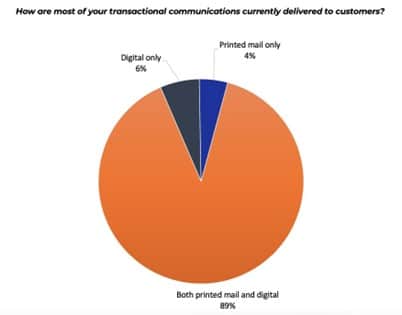
N = 291 Total Respondents
Source: Customer Communications Direct Marketing Business Survey; Keypoint Intelligence 2025
Transactional print and mail and digital collaborations
Both digital and print communications must stand on their own. But there’s also compelling opportunities to improve customer satisfaction, on-time payments, loyalty and other business priorities by capitalizing on the interplay between the two.
An omnichannel communication platform gives companies the control, agility and scalability to enable print and digital collaborations that would be difficult to achieve with different systems, processes and vendors. Here’s how you can implement it in your business:
Blend digital and print. Companies can increase customer convenience and ease of use by adding interactive digital elements in physical communications, such as QR codes to expedite payments and persistent URLs (PURLs) that link to online customer information and other resources. They also can finetune outreach by tracking click-through rates and engagement and collecting data for analysis.
Personalize across channels. An omnichannel CCM platform not only lets companies meet customer expectations for delivery channel choice, it allows them to customize content by customer or customer segment–all while also keeping messaging personalized and consistent across channels. At the same time, print providers with sophisticated variable data printing capabilities can produce personalized paper bills and other communications.
Automate print backups for digital misfires. Transactional print and mail services provide an important backup when emails or text messages bounce or remain unopened. With the omnichannel communication platform, companies can set up delivery channel sequencing and timing to automatically trigger the production and mailing of a paper copy of any failed or unopened digital communications.
Reduce costs and inefficiencies. By unifying development and distribution of digital and print communications on one platform, companies eliminate redundant workflows, keep branding consistent and consolidate approvals, updates, tracking, reporting, analyzing and archiving all communications. Promoting digital adoption in paper communications can shift costs away from printing and mailing.
Streamline compliance. With a single platform, companies can apply compliance rules uniformly to all communications. Because companies use their omnichannel solution to create and store blocks of content, including disclosures, mandatory opt-outs and other compliance language, they also can make regulatory or legal changes in one place that automatically populate in the necessary print and digital communications.
Gain real-time visibility and tracking. Companies can increase visibility and reduce delivery uncertainty, which is a growing issue with time-sensitive transactional print and mail, by enabling mail tracking services. Combining mail tracking with online monitoring and reporting of engagement metrics such as open rates, click-through rates, and opt-outs gives companies an up-to-date and complete view into their communications programs. Consolidating the tracking information across channels simplifies reporting and analysis.
Apply security and privacy measures consistently. Instead of increasing risks with multiple vendors, a single secure platform for print and digital centralizes strict governance for data handling and ePresentment, including using encryption and other measures for data in transit and at rest. It also ensures all communications comply with industry standards, including HIPAA and SOC 2 Type 2, and are fully auditable. Of course, transactional printing and mailing operations need additional safeguards, with stringent physical security and privacy policies and practices that are typically limited to providers that specialize in regulated and sensitive customer communications.
Customer communication leaders are building programs that make the most of print, digital and the combination of the two. They are leveraging the strengths of each channel as well as their synergies to improve customer experience, cashflow and repeat business.
Key Takeaways:
- Transactional print and mail remains an essential component of strategic customer communications programs.
- Leaders are leveraging their omnichannel communication platform to seamlessly manage and execute both print and digital communications.
- Unifying digital and print communications allows companies to meet diverse consumer expectations, improving customer engagement and business outcomes.
Discover how Nordis helps organizations blend transactional print with digital communications on a single omnichannel CCM platform. Request a demo today.