



For years, credit and collection leaders who delivered Model Validation Notices (MVNs) via text messaging have operated in a gray area. All were confident in the consumer experience but some less certain how it would hold up in court. That changed in May.
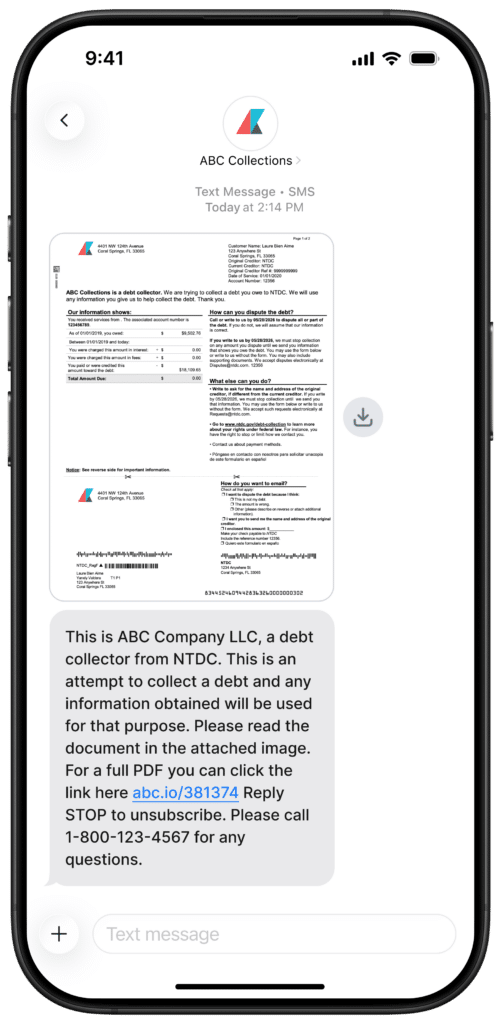
A federal district court in Florida ruled that a debt collector satisfied the Fair Debt Collection Practices Act (FDCPA) validation notice requirements by sending the notice via text message with a secure hyperlink to the full disclosure, one of several digital formats collectors are using today alongside email and embedded PDFs in MMS messages. [Credit and Collection News] [AccountsRecovery.net]
Text-based MVN delivery is not a new application. What’s new is that a court has now put its weight behind the approach, giving credit and collections leaders something they haven’t had before — legal grounding to scale a channel their recipients already prefer.
The best option is having options
The spring ruling on text-and-hyperlink format is one federal district court’s decision, not a nationwide rule, and it doesn’t erase the risk entirely. Earlier cases involving poorly executed hyperlink delivery, such as multi-step processes, buried links, confusing access requirements, ended with different rulings. The channel wasn’t the deciding factor, it was how clearly the collector presented the notice, how easily consumers could access it, and how well the collector documented the process.
That’s why organizations should not center their compliance posture on a single format, but rather on the clarity, accessibility, and traceability. Some collectors will want to send an MVN by text message with an embedded PDF. Others will prefer a secure hyperlink. Others may lean on emailing the notice — or want the flexibility to move between formats depending on the consumer or how the legal landscape develops. The leaders aren’t the ones who picked the “right” channel. They’re the ones working with a partner that uses an omnichannel communication platform that can execute all of these formats seamlessly.
Why the timing matters
The ruling lands at a moment when the pressure to get validation notices right and the pressure to modernize how collectors deliver them are both intensifying.
On the compliance side, the Consumer Financial Protection Bureau’s most recent FDCPA Annual Report shows debt collection complaints nearly doubled year-over-year, and the Bureau’s supervisory exams specifically flagged validation notice failures as a recurring issue.
On the consumer side, industry data shows the shift is well underway:
- Text/SMS adoption jumped from 45% to nearly 60% year-over-year, with online portal usage climbing from 52% to about 59%, according to TransUnion’s 2025 Debt Collection Industry Report, clearly pointing toward channels that connect consumers to self-service payment journeys.
- Credit and collection professionals ranked SMS the number one channel for consumer engagement, ahead of email, web portals, and the phone, per AccountsRecovery.net’s 2026 Digital Communications Pulse Report.
Two forces are converging, with regulators expecting more precision and consumers and the companies who serve them expecting more from text.
From marketing channel to compliance channel
That convergence changes how collectors should treat SMS and MMS. Text messaging for collections needs to be governed with the same rigor as a printed and mailed legal notice, with controlled content, documented consent and opt-out handling, secure hyperlinks and a complete audit trail for every message sent.
That’s the model behind Nordis’ Expresso® platform for credit and collections management and its partnership with Solutions By Text (SBT). Expresso enables embedded MMS delivery of MVNs with secure, trackable links, backed by Digital Communication Records™ that sit alongside the same governance already applied to print and email notices. One system of record, not a patchwork of point solutions.
Because MMS can carry images along with text, it lets a collector include a recognizable logo or a branded header, even a preview of the notice itself right in the message, without exposing account detail or anything else that shouldn’t be visible.
A consumer who sees a familiar brand is far more likely to trust the message and tap through than one who sees plain text from an unfamiliar number. For something as consequential as an MVN, that extra layer of trust can make the difference between engagement and a message that goes unread.
Business case proof points
Compliance aside, the performance data for text messaging in credit and collections already makes the case. According to Solutions By Text:
- A national lender’s text payment campaigns generated payments at a 2:1 rate compared to traditional methods, freeing agents to focus on complex accounts instead of routine payment processing.
- A collections agency doubled self-service payments, from 20% to over 40%, using SMS payment reminders paired with SBT SmartURL®.
- Across financial services, text-based payment workflows saw 5–20% payment acceptance rates, with 90% of payments occurring within the first hour of the text being sent.
Compliance and performance aren’t competing priorities. A well-managed text messaging capability delivers both.
What collectors should do now
If your current communications technology can send a text reminder but can’t demonstrate consent capture, content control and delivery documentation for a compliance-critical notice like an MVN, this ruling is a good prompt to close that gap. The goal isn’t just adding another channel, it’s bringing text messaging, and especially MMS, inside the same platform that already manages your print and email communications.
Look for us at the ACA conference
Nordis will be exhibiting at the ACA International 2026 Convention in Orlando this month. Visit us at Booth #509 and join us on July 23 at the Innovation Stage for Incorporate Advanced Texting Capabilities into Omnichannel Communications, where we’ll show what compliant, high-performing text messaging strategies look like in practice.