


Why the DCR™ Works.
For years, customer communications management followed a familiar formula: Develop a document, produce it, send it, and store it.
Today’s consumers have outgrown document-only communications. They move fluidly across print, email, text, portals, and payment channels, expecting each interaction to be timely, personalized, consistent and easy to act on.
Simply offering multiple delivery channels is not enough when they are managed as disconnected outputs.
Companies need to meet their customers’ expectations, while accelerating payments, maintaining compliance and making operations more efficient, even as all grow more complex.
Modern communications require DCRs
The solution is the Expresso Digital Communication Record (DCR), exclusive to Nordis Technologies and central to the Expresso® customer communication management platform. The infographic below illustrates how the AI-enhanced Expresso platform works behind the scenes for clients, bringing together data, composition, delivery, payments, and business intelligence to optimize the customer communications and payments lifecycle.
It gives companies a unified framework to orchestrate all communication types, formats and channels, enable payments, measure response and payment behavior and adjust outreach to improve results. Anchored by DCRs, this flexible model also makes it easy to adapt to changing business, compliance and customer dynamics.
From communication to customer action
View the full infographic that illustrates the Expresso workflow and its built-in feedback loop to continually strengthen business outcomes.
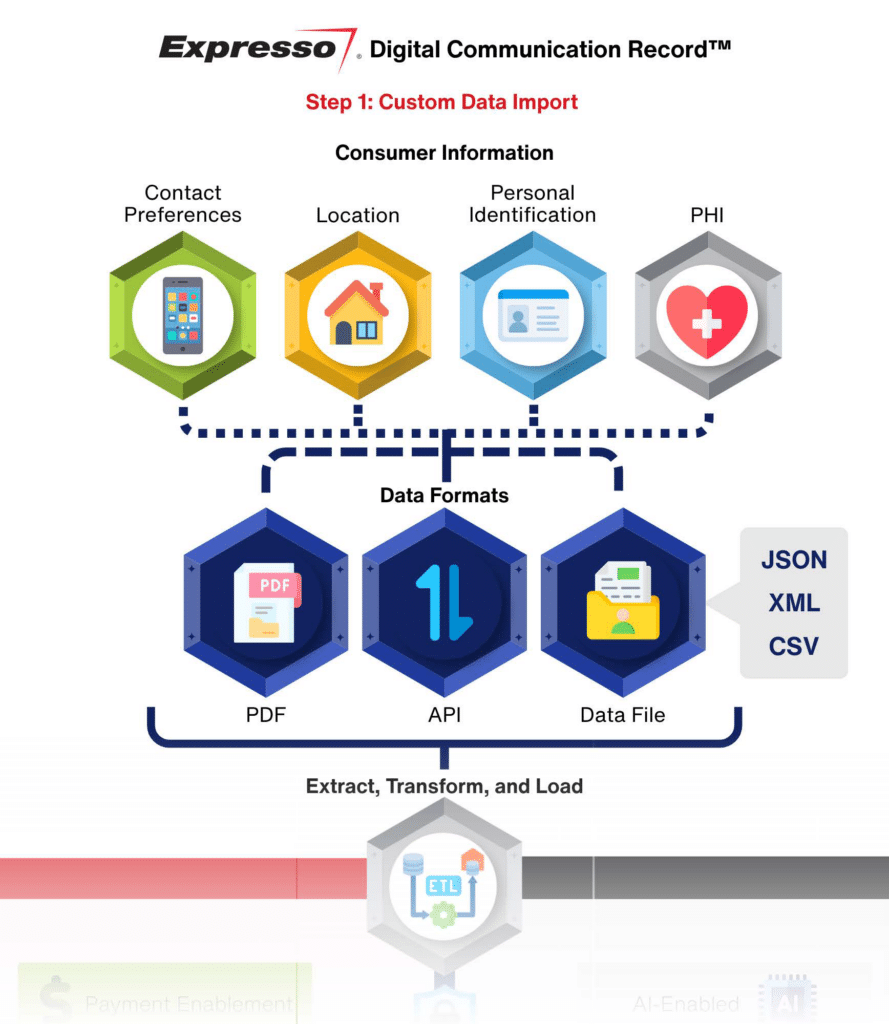
Step 1 – Custom Data Import
Consumer information from multiple systems and formats, including data files, APIs and PDFs, flows into each client’s unique Expresso configuration with programmed business rules. AI-powered chat tools will soon support easy, effective program management.

Step 2 – Customized Configuration
Expresso creates the DCR, an enriched communication record that brings together the client business rules, consumer data, channel delivery instructions, embedded quality controls and Nordis’ service level agreements and payment imprints.
The platform-led DCR technology unifies communications and payments data, creating an end-to-end governing record for performance and compliance reporting.
This is especially important because companies need more than proof that a communication was sent. They need to know how it came together, what rules shaped it, where and when it went and what happened next.
That traceable path is data lineage. In Expresso, the DCR preserves that lineage across communication, delivery, payment, and response, providing both a defensible record and insights to help streamline time to payment.
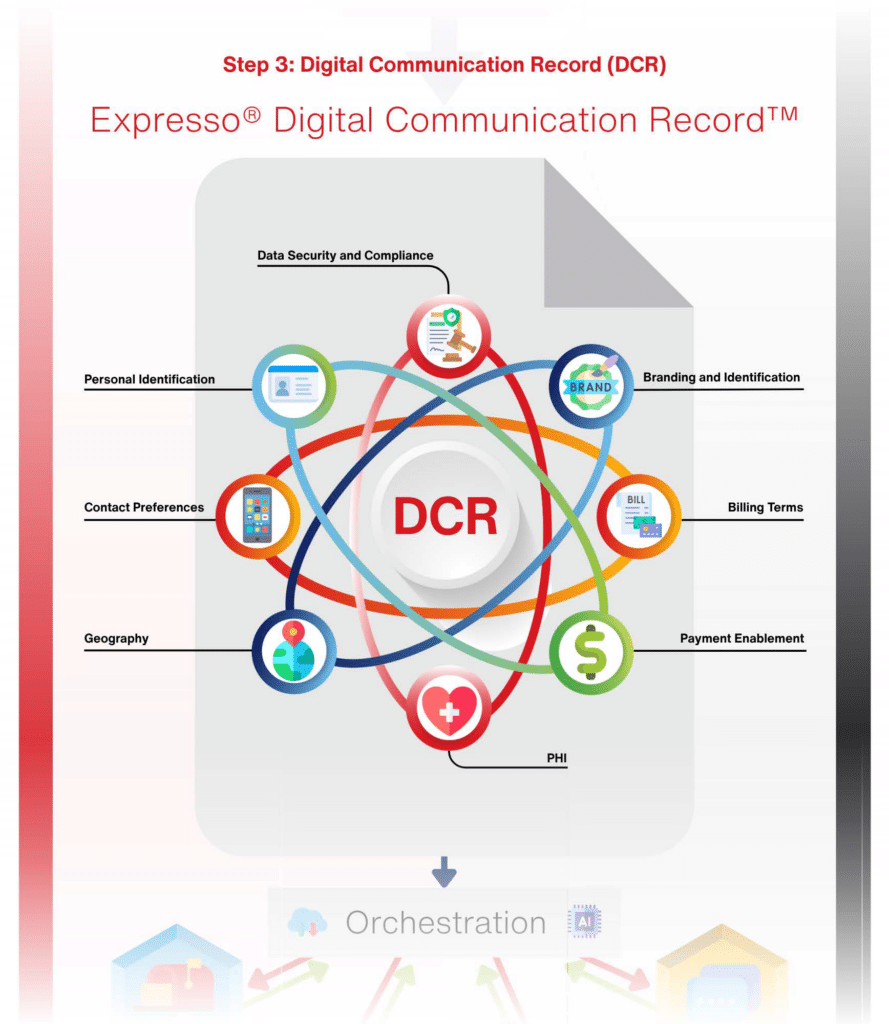
Step 3 – Digital Communication Record
With the DCR, Expresso generates customized billing statements, letters, notices, payment reminders and other mobile, digital and print communications. Built using each client’s pre-set templates and packages, these communications can include personalized messaging, branding, billing terms, payment options, disclosures, customer service information, offers and other content.
Payment-enabled DCRs allow companies to tightly link billing and other communications to customer payments, compressing what has traditionally been two events separated by time into one, encouraging prompt action. Clients can add payment portal links, QR codes and automated voice response options to print, mobile and digital communications, making it fast and easy for customers to respond.
Another key to reducing payment friction is accepting streamlined payment methods such as Apple Pay and Google Pay as well as new one-click payment options, so customers don’t have to hunt down and enter bank account or credit card information.

Step 4 – Omnichannel Orchestration
Expresso is an omnichannel communication platform that orchestrates the distribution and coordination of communications across physical and digital channels for each customer based on their preferences, behavior, and account status.
For example, a customer may receive a monthly statement by mail and by email. The company may also send the same individual a refinancing offer via email, a payment link in a text message, and a QR code on a mailed past-due notice.
Consumers are twice as likely to pay promptly when a bill arrives through their preferred channel, according to a 2026 Cedar report analyzing 1.5 billion patient financial interactions.
The Expresso orchestration capabilities will soon go beyond meeting channel preferences to matching communication messages, timing and payment path to get the customer to take the desired action, such as paying a bill.

Step 5 – Results and Analytics
The communication lifecycle doesn’t end when a company sends a bill or notice. Each interaction leaves behind insights that are captured and can improve the next one.
Expresso collects results and customer behavior information and augments the DCR with this data. The data will feed into Expresso’s AI-enabled data and analytics resource ExpressoHub™, as well as Expresso’s Report Management tool for customized reporting.
As Nordis adds more AI-enabled capabilities, Expresso will support near real-time reporting and analytics, which, in turn, will help clients update and optimize their programs.
In the future, ExpressoHub™ will automatically aggregate and deliver outcomes into the Expresso dashboard. Clients will be able to bring their DCR data into their own data warehouses via API or augment their own AI data sources by connecting to ExpressoHub via Model Context Protocol (MCP), a secure standard that allows AI tools to connect to and use approved data sources. Instead of guessing which outreach drove action, organizations will gain powerful insight into what actually advanced engagement with the consumer.
DCR drives better CX and business results
DCRs enable companies to shift from sending one-way documents to delivering interactive customer experiences that reflect how each consumer wants to receive transactional communications and interact with them.
More broadly, AI-enabled Expresso and DCRs help companies move beyond traditional CCM approaches focused on production, channels, formats and legacy economics. A stronger business strategy starts with understanding which communications reduce confusion, change behavior, lower call volume, increase trust and matter most to customers.
As industry expert Andy Young noted in his May 6 Substack post. “The larger prize is proving that communications improve outcomes.”
Expresso is the only customer communication management platform that features DCRs to give companies a practical way to connect communications, payments, data and outcomes within a single, governed framework. That visibility helps organizations move beyond one-way document delivery and toward customer interactions that are easier to act on, measure and improve.
Contact us today for more information about leveraging DCRs.